


Gone are the days where a businesses brand is set in stone, a ticked-box on the to-do list, a...

Outsourcing or ‘white label’ graphic design and creative has proven to be an increasingly popular strategy over recent years, both for agencies and in-house creative teams.
Despite agencies in general having a tough time of it in the last two years1, the Graphic Design outsourcing market is now a £3.6bn revenue market in 2023, with growth predicted at a CAGR of 10.7% from 2024 to 20322.
So what’s driving this change?
To outsource or not to outsource
When looking to add design resource, there are two options: either invest in-house and recruit, or outsource. In general terms, the benefits of having an internal team at your fingertips are clear, but it comes at a cost. Not just the ongoing financial commitment (they’re a long term commitment straight off the bottom line), but the management hours, holiday and sickness, training, capability gaps, hardware and software, and that unspoken issue - in-house inefficiency. In-house inefficiency is the utilisation black hole, the average 35%5 of unchargeable time that staff members spend that the business has to swallow, either working on internal jobs, reading emails and professional admin, or where the workload just isn’t there.
Of course, there is a balance to be struck, what works for one business may not work for another.
According to Deloitte4, there are three core drivers in the shift to outsourcing design:
- Capacity and flexibility
- Access to specific skills
- Cost reduction
Reasons to outsource design
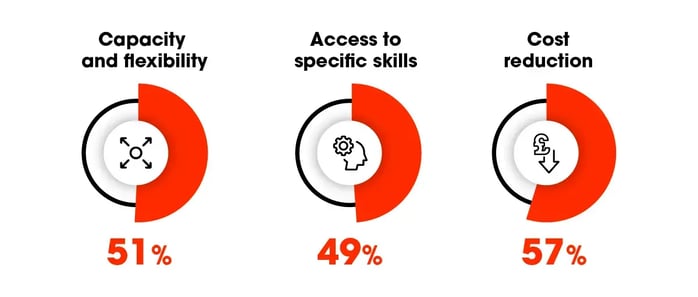
Source: Deloitte4
1. Capacity and flexibility
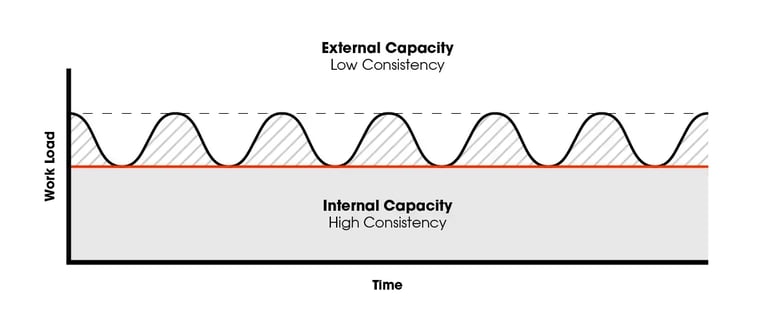
Rarely do teams have a steady consistent workload, there are peaks and troughs. The ideal business model has enough permanent resource to cover the troughs, and flexible options for the peaks. And to be in a position to respond to opportunities and move quickly for clients, flexibility is key. Being able to shuffle your pack can be the difference between winning and losing key accounts.
2. Access to specific skills
Some key skills and disciplines are just not feasible or cost effective to in-house, but are still required on a regular basis. It could be a 3D animation, a complex UX or UI design, video work - things that require specialist skills but on a sporadic infrequent basis. Partnering with an agency gets you that depth of skills and capabilities, from one point of contact.
3. Cost reduction
The hot topic, ultimately any solution needs to be both cost effective and provide maximum bang for the buck. You will likely spend more per hour with an agency but you balance that with 100% utilisation. As outsourcing design also reduces fixed liability in the business, it’s not only a smaller spend but is a lot lower risk to boot.
Achieving 100% utilisation and beyond
In a tough economic climate, businesses and agencies are striving for efficiency, and crunching the numbers to find marginal gains. Outsourcing design is a quick win strategy. It’s a great way to achieve maximum efficiency with design and creative. This obviously comes at a short term financial cost, as the rate you will pay an agency is going to be far beyond that of an internal employee. But crucially, your are getting 100% utilisation. And with the right partner, commonly overall costs are reduced.
The actual cost of a single experienced and capable in-house designer on a £40k salary, would be somewhere in the region of £54k, an effective day rate for around 230 days work of £232.
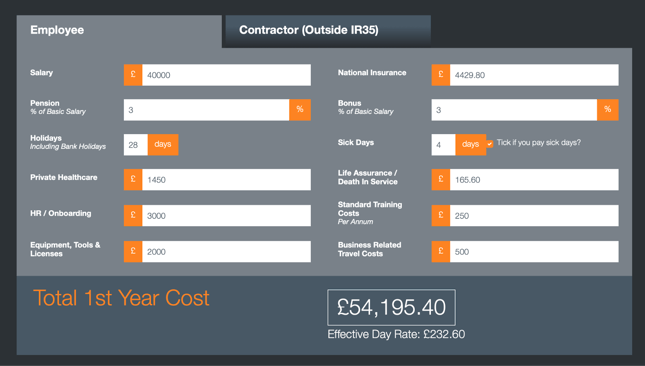
When you consider a design agency could charge a day rate of as little as £440pd, a spend of £69k per year would achieve 157 productive days. But there’s no need to commit that much time. £40k per year with an agency could represent a value of 90 days worth of productive design work, 7.5 days per month. Work that’s done by an experienced, always-on team, with a broad range of capabilities.
100% utilisation, 0% waste, great work.
Beyond this, there are further benefits:
• Capacity to scale when busy, and disappear when not
• No commitment
• Access to a range of skillsets
• Access to experienced specialists
• Senior design direction inclusive
• Fresh creative perspectives
• Continuity (your work isn’t in one person’s head, so won’t be lost when they leave)
• A team project management team to schedule, support and proof
• No complacency
The last one is key. Agency’s are only ever as good as their last job, and use every job as an opportunity to prove themselves. This isn’t the case with internal teams.
Can you have the best of both worlds?
This is what many in-house teams and agencies are coming around to. A common model seems to be a core skill set of senior experienced creatives, the red thread that runs through everything the business does and answer the core strategic creative questions. Supplemented with a core partner or selection of reliable, flexible partners, the do'ers who know the brand inside out, offer a fresh perspective and fulfil the studio requirement.
Utilisation would not be 100%, but there would certainly be a vast improvement and a lot less business risk and fixed cost tied up in permanent employees.
Any agency or in-house team has peaks and troughs in capacity, but need to be able to accommodate their clients when workload hits peak levels. This inevitable balancing act is made much less stressful when there's a managed team of talented creatives that are embedded with your ways of working, with a single point of contact and available on-demand.
Add to this the increase in capabilities and niche skillsets that you get from outsourcing to a specialist design studio, and it's clear why this strategy is increasing in popularity for in-house creative teams.
Conclusion: Find the right partner
Each business is unique and must find the solution that fits their needs. But with a noticeable tide shifting to an outsourcing model for design work in the UK, it’s a model that shouldn’t be ignored. If you’re looking to explore the outsourcing model for your design work, it’s advisable to arrange a chemistry call with the design agency and make sure they’re a good fit. Understand their skillsets and make sure you can cover off the core competencies that you will require (animation, illustration, packaging artwork etc). And arrange a few test brief’s to make sure the process and quality is where you need it to be.
Outsourcing design isn’t for every business, but it’s clearly a strategy that’s growing in popularity for UK agencies and in-house creative teams.
At ZAP we specialise in whitelabel agency support. If you're interested to see how it could work for your business, feel free to get in touch and arrange a no-obligation consultation with one of our experts.
Outsourcing design isn’t for every business, but it’s clearly a strategy that’s growing in popularity for UK agencies and in-house creative teams.
At ZAP we specialise in whitelabel agency support. If you're interested to see how it could work for your business, feel free to get in touch and arrange a no-obligation consultation with one of our experts.
SOURCES
1. https://www.ibisworld.com/united-kingdom/market-size/graphic-design-activities/#:~:text=The%20market%20size%2C%20measured%20by,industry%20increased%203.5%25%20in%202022.
2. https://www.openpr.com/news/3485850/graphic-design-outsourcing-service-market-survey-report-2024
3. https://www.thewowcompany.com/download-agency-benchpress-2023
4. https://www2.deloitte.com/us/en/pages/operations/articles/global-outsourcing-survey.html
5. https://www.synergist.co.uk/resources/guides-and-more/agency-utilisation-rates-everything-you-need-to-know